|
QF-104A target drones The USAF converted 24 Starfighter to QF-104A target drones. | ||
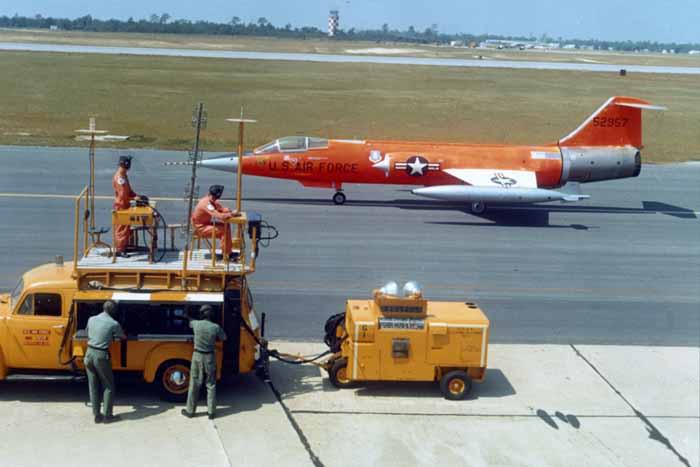
| 55-2957 | YF-104A | QFG-957, mentioned is a “dog fight” mission against a F-4D on July 19, 1967, shot down as a drone August 8, 1967, no further details known; 4 drone flights. After a period of being a JF-104A test aircraft it was converted to QF-104A at Palmdale in 1961. It departed Palmdale on March 10th 1961, arriving at Eglin the next day. From November 1st 1961, that year, the aircraft was selected for drone test operations modifying it to JQF-104A. on July 29, 1965 its test program had ended and it returned back to the operational drone fleet at Eglin as QF-104A. July 19, 1967 it flew a "dog-fight" type mission, including 3G turns at 1.2 Mach at 18.000 feet, with a US-Navy F-4D Phantom. This was also the first mission flown with an F-104D chase aircraft. The mission went ok and the aircraft landed safely at Eglin again. On August 8, 1967 it was shot down as a drone. |
| 55-2963 | YF-104A | QFG-963, painted orange overall, was shot down February 1, 1962 by Bomarc surface-to-air missile on 1st drone flight. In 1961 this aircraft was modified to QF-104A and added to the AFSC section for drone testing at Eglin in September that year and prepared for the first unmanned operations while flown by pilots. On February 1, 1962 it was hit and sequentially shot down by a BOMARC ground-to-air missile. It was totally destroyed. It took place on the aircraft's first "unmanned" flight and was the very first QF-104 shoot down. |
| 55-2965 | YF-104A JF-104A | QFG-965, QF-104A modification November 1964, JQF-104A modification November 8, 1965, shot down March 1, 1967 by AIM-4D; 5 drone flights. This ex JF-104A test aircraft was modified to a QF-104A at Lockheed Palmdale in 1962. It was however delivered to McClellan AB on July 30, 1962 where it was put in storage. In July 1964 it was taken out of storage and prepared for drone operations. It was delivered to the 3205th Drone Squadron at Eglin Air Base, November 6, 1964. They modified it immediately to JQF-104A test drone aircraft for testing new modifications. On March 1, 1967 this Starfighter was "killed" as drone by a AIM-4D missile from another jet. |
| 55-2966 | YF-104A | QFG-966, written off June 14, 1967, lost pitch control, destruction failed, guided over the Golf of Mexico until it flamed out; 3 drone flights. Just as its sister aircraft 2965 also this ex JF-104A test aircraft was modified to QF-104A at Lockheed Palmdale in 1962 and put in storage in July 1962 at McClellan. It arrived at Eglin in March 1965 where it was modified to JQF-104A test drone aircraft. OnMarch 21,1967 this Starfighter returned to base from an unmanned mission. But during the landing the aircraft lost the anti-skid brakes and blew both main tires. The aircraft stopped without any damage and could fly soon again. During another unmanned flight on June 14, 1967 the ground controller lost all pitch control. The QF oscillated between 17m and 40m feet. The chase aircraft, being a manned QF-104A, stayed with this drone. The DT-33A managed to join up and take control of the sick QF-104. Still unable to control pitch the DT-33 controller tried to destruct the drone but once again the self-destruction packed failed to operate. The QF was then put in an orbit and flown over the gulf of Mexico until it flamed out and was guided to impact in the sea. It was determined that the loss of voltage was occurring between the batteries and the package itself, due to too many relays etc. This problem was solved for the other QF-104s. |
| 55-2968 | YF-104A | QFG-968, lost in the Golf of Mexico on September 14, 1962 being out of control on 2. unmanned drone flight; 2 drone flights. This old pre-production aircraft had been in storage since December 1959 when being repaired after it encountered an accident (ARDC) on May 3, 1957. The USAF selected this aircaft to become a drone and it left MASDC storage facility for Lockheed Burbank in July 1960. In November 1960 it was transported to Lockheed Palmdale and then again moved to Burbank in February 1962 where it was modified finally to QF-104A. In April 1962 it arrived at the drone flight at Eglin Air Base. On September 14, 1962 it was lost in the Gulf of Mexico. It happened during its second unmanned flight and seems to be caused by technical problems (likely loss of control). |
| 55-2969 | YF-104A | QFG-969, September 28, 1968 hit by AIM-9, recovered, flown again, shot down January 26, 1971 with AIM-4H, fired from F-4E; 25 drone flights. This General Electric test aircraft had been returned to the USAF in August 1961 and directly transferred to Lockheed Palmdale in September. In February 1962 it was transported to Lockheed Burbank and in August 1962 it arrived at McClellen for IRAN overhaul but also QF-104A modifications and preparations. It was delivered to Eglin on June 11, 1964. At Eglin it got nickname "Capt Sassey" due to the fact that it"s engine always made a "Sassling" sound. On July 1st, 8th and 14th, 1965, this QF-104A flew similar drone test missions at 35.000 ft at a speed of MACH 1.8. All missions went as planned. On the 23rd that same month it repeated this tested mission followed by being a target for a missile shooting exercise. The missile pulled 25 G's while tracking the Starfighter. The Starfighter was avoided and the Starfighter could land again safely. On September 28, 1968 it flew an unmanned drone mission. During this mission it was hit under its left wing by an AIM-9 missile fired by a USAF F-4 Phantom. Gladly the aircraft could be brought/controlled back home and it landed ok. The controller only encountered some trouble controlling the heading on landing. There was no other damage and the aircraft could be repaired. On January 26, 1971 the end of this Starfighter was a fact when it was shot down as drone by a AIM-4H missile fired from a USAF F-4E Phantom. This was on its 25th mission. |
| 55-2971 | YF-104A | QFG-971, on December 8, 1965 the QF-104A was hit in its nozzle area by an AIM-4 during an unmanned mission. The "damaged" aircraft could be landed, but blew a tire during the landing with no further damage to the QF-104. It was repaired and
flew again soon; during “weather penetration” mission on June 21, 1966 struck 3 times by lightning strikes; shot down October 27, 1966 by AIM-7; 11 drone flights. This ex USAF test aircraft which had sustained a lot of accidents during its career, was selected to become drone in 1960. It arrived at Lockheed Palmdale in November 1960 and was transferred to Burbank for final modifications in February 1962. On April 24th 1964 it was delivered to Eglin as new drone and was added to their operational drone fleet. Not all the missions flown were "shoot to kill". Many were programmed misses just to check missile tracking capabilities, contact ranges etc. For example July 8, 1964 when this QF-104A flew such a type of mission. It had 7 missiles fired at but there were no hits. On December 8, 1965 it was hit in its engine nozzle area by an AIM-4 missile during an unmanned mission. It could be landed but blew its tire during this landing with no further damage to the QF-104. It was repaired and flew again soon. On April 26, 1966 it flew the first socalled "weather penetration" mission for a QF-104, which went as planned. There were no problems. On June 21, 1966 it became the luckiest aircraft in the world. During an unmanned mission it was struck three times by lightning. All it did was blow some circuit breakers. Nevertheless the QF-104 could be landed without any problem. Finally on October 27, 1966 the aircraft was lost. It was shot down by an AIM-7 missile. |
| 56-0730 | JF-104A | XQF-104A QFG-730 in June 1960, lost canopy during take-off on June 6, 1963, written off October 26, 1967, lost pitch control, destruction successful; 14 drone flights. Lockheed converted this ex JF-104A to XQF-104A prototype in June 1960 after USAF was interested in a possible drone program. It flew tests at Eglin Air Base in December 1960 and moved back to Lockheed in November 1961. There it was modified back to generic QF-104A drone and transferred back to the 3205th Drone Squadron at Eglin Air Base in October 1962. On June 6, 1963 this QF-104A took off for a mission but during this take-off it lost its canopy. The aircraft could be recovered and was ok. A few days later, June 10, it encountered a barrier engagement on landing. On May 17, 1967 the aircraft toke off for an unmanned mission. During the take-off the doors failed to close. The controller re-cycled the gear and tried to close the doors again, which succeeded. The aircraft went on and flew a good mission. On October 26, 1967 it was lost while it flew an unmanned mission at 1.4 Mach at 30.000 feet when the controller lost pitch control of the QF. The drone zoomed to 40.000 feet, then down, then back up to 55.000 feet. Last airspeed recorded by telemetry was 800 kts while the QF was going down again vertically. At the end the drone was destroyed by a correctly operating destruct package. |
| 56-0733 | JF-104A | QFG-733, on November 29, 1961, designated JQF-104A, on May 31, 1968 it suffered a severe class A landing accident at Eglin AFB, re-modified to F-104A in May 1970, used by Darryl Greenamyer between 1974 till 1977 for spare parts (N104RB race-jet),
used for Japanese movie purposes as "36-5019" at Mojave AP in 1987, display at Science Fiction Air Park at Arlington, Texas coded with fake serial 56-763/FG-763, preserved at Historic Aviation Memorial Museum (HAMM) in Tyler near Arlington, Texas in April 2005, restauration in 2005,
markings with code 56-733, August 6, 2006 last noted. In August 1967, after modifications and overhaul at McClellan, it was delivered to Eglin Air Force Base as QF-104A. On May 31, 1968 this Starfighter encountered a severe class A landing accident at Eglin AFB but they thought it could be repaired soon again. In October 1968 it was brought over to Wright Patterson (Lockheed detachement) for repair but it was damaged more than expected and transferred to the Lockheed facilities at Palmdale. There the damage was estimated as too severe (structural damage) and the airframe went into storage and lateron withdrawn from use. Nowadays it can be found preserved at Tyler Air Base with 83 FIS markings. |
| 56-0734 | F-104A | QFG-734 on May 14, 1962, August 10, 1962 barrier engagement, September 7, 1962 barrier engagement, third barrier engagement in 1962 took place on September 12, but then the aircraft sustained major damage while it collapsed on February 6,
1963 barrier engagement, shot down August 1, 1963 by Bomarc surface-to-air missile; 114 drone flights. After being used by USAF and NASA for various test programs it ended up with Lockheed Palmdale in January 1961. It received maintenance and upgrades and was converted to QF-104A drone. As QF-104A it was delivered to Eglin Air Force base on June 14, 1962 and added to the drone flight. While returning from a flight on August 10, 1962, it engaged the barrier on landing at Eglin. Gladly everything went fine and there was no damage. On September 7, that year it engaged the barrier again and again it did not systain any damage. Then 5 days later it sheared its nose-gear on landing. The damage was minor and aircraft could be repaired soon. On February 6, 1963 the aircraft engaged (again) the barrier on landing. The aircraft did not brake and did not pull out its dragchute. This could have been the result of a failure of "weight on nose gear switch" malfunction. The aircraft could however fly again soon. Finally on August 1, 1963 the aircraft was shot down as umanned drone, by a BOMARC missile. |
| 56-0735 | JF-104A | QFG-735 converted to JQF-104A on September 18, 1961, barrier engagement on May 9, 1963 with broken nose gear, repaired barrier engagement on September 2, 1964, shot down June 17, 1965 by AIM-7 from F-4 of US Navy; 11 drone flights. After manufacturing in January 1957 this Starfighter stayed with Lockheed to test new updates and versions. When there was no need anymore to keep this aircraft it was modified to QF-104A drone in September 1961 and delivered to Eglin AFB. With the 3205th Drone Squadron, on one of its missions on May 9, 1963 this aircraft made a bad landing damaging its nose gear. Gladly it could be repaired. In February 1964 it returned back to service at Eglin. On September 2, 1964 it engaged the barrier on landing after it did not brake and did not pull its dragchute. The aircraft was made fly-worthy again soon after some repair. Finally the aircraft was shot down as drone when on June 17, 1965, by an AIM-7 missile which was shot from a US-NAVY F-4 Phantom. It was completely destroyed. |
| 56-0736 | F-104A | QFG-736 on March 31, 1962, shot down by missile on October 4, 1962 on the 5th drone flight. After being used by the US Navy at China Lake for two years and subsequent MASDC storage period it went to Lockheed Palmdale in November 1960 for maintenance and upgrades and to Lockheed Burbank in February 1962 for QF-104A drone conversion. In April 1962 it was delivered to Eglin AFB for drone operations. On its 5th unmanned flight on October 4, 1962, this drone was shot down by a missile during a shooting exercise. |
| 56-0737 | JF-104A | accepted by USAF May 23, 1957; delivery date May 24, 1957; AFFTC ARDC (Air Research and Development Center), Edwards AFB, CA (1957-April 1958) (to JF-104A); 1958 at NAF China Lake with Navy
Missile Center (NMC) for supersonic Sidewinder missile tests of USAF; 83rd FIS Hamilton AFB, California; TPS (Test Pilot School); TTF (Target Towing Flight) at McClellan AB, California March 1959; arrived at Lockheed,
Burbank, CA for QF-104A conversion June 1960; QF-104A QFG-737 on October 31, 1961; assigned 3205th Drone Squadron, Eglin AFB, FL November 1961; May 4, 1971 porpoised (bounced) on landing; 3205th DS June 25, 1971
hit by an AIM-9 Sidewinder missile, resulting in a fairly large hole in the right rear fuselage, aircraft was recovered safely, repaired and put back on flight status; damaged on landing June 1, 1972, repaired and flew
again June 16, 1972; shot down on July 3, 1972 by an AIM-9J Sidewinder on its 21st unmanned mission at 10.000 feet at 0.95 Mach speed. It was the last QF-104 loss/shot down during the QF-104 drone program. After a period of being used as test aircraft with the USAF and missile firing by US Navy at China Lake, this aircraft arrived with Lockheed, Burbank for QF-104A conversion in June 1960. It was used for a lot of drone test missions for many years at Eglin from around November 1961. Ten years after delivery, on May 4th, 1971 this aircraft flew an unmanned mission at 19.000 feet and 1.1 Mach. Again a 72 degree bank was flown at missile firing. After this mission it made a bad landing which resulted in a bent nose gear axle. On June 25, 1971 it was hit by an AIM-9 sidewinder missile. The drone was damaged in the right rear fuselage resulting in a fairly large hole in the side. The controller had some trouble controlling the heading on final approach but at the end he was able to land the aircraft safely. Of course there was a lot of repair neccesary to get it back in operation. A year later, after repair, on June 1, 1972 it returned from an unmanned mission and everything went well during the landing until it entered the end of the runway. It ran off to the right side of the runway and returned back on the runway and could continue taxying to the flightline. It resulted only in minor damage, it could fly again on June, 16. Finally on July 3, 1972, the aircraft was lost when it was shot down by an AIM 9J sidewinder missile at 10.000 feet, at 0.95 Mach speed from an other fighter. It was the last day that a QF-104 was lost during the QF-104 drone program. |
| 56-0739 | F-104A | XQF-104A QFG-739 in April 1960, shot down October 8, 1963 by GAR-2B (Sidewinder) missile; 1 drone flight. After a long period of being used as test aircraft and even being hired by Convair as chase-plane during testflights of their aircraft, it arrived at Lockheed, Burbank in March 1959 and selected to be modified into XQF-104A drone prototype aircraft. The test-episode for this XQF-104A, which started Januar 9, came to an end on October 16, 1961. The aircraft was also used for illustrations inside the manual "T.O. 1F-104(Q)A-1". In May 1963 it was added to the operational drone fleet at Eglin as standard QF-104A drone. On October 8, 1963 it was lost when it was "killed" by a GAR-2B missile shot by an other aircraft. The Starfighter was completely destroyed. |
| 56-0741 | JF-104A | QFG-741 on November 30, 1961, April 24, 1971 barrier engagement, lost on landing on May 16, 1972 after loosing control of the drone; 22 drone flights. In May 1957, after manufacturing, it was added to the Lockheed test facility for own factory testing. This ended in May 1959 when it was transferred to McClellan for maintenance. From September 1959 it flew as testaircraft for engine manufacturer General Electric until January 1960. After some months being stored at MASDC it was selected to become a QF-104A drone. Conversion at Lockheed finished November 30, 1961 and next month it was delivered to Eglin AFB. One of the unmanned succesfull missions was flown for example on July 24, 1968 when it flew at 1.3 Mach at 30.000 feet. An other example was an unmanned flight on April 24, 1971. Now it flew at 1.28 Mach at 24.000 feet when the plan was to shoot it down. It was in a 72 degree bank turn at the moment of missile firing. It survived and returned base where it engaged the barrier at 80 Kts on landing. Sadly on May 16, 1972, the controller lost control of the aircraft on landing back at Eglin after a test mission. On final approach it crashed 2-3 miles short of the runway and was destroyed. |
| 56-0743 | JF-104A | QFG-743 on November 17, 1961, written off September 25, 1968, lost pitch control, crashed into the golf of Mexico; 2 drone flights. This Starfighter was one of a number of Starfighter being used at Edwards for verious test and chase flight (X15) duties in the early days. In April 1960 its duty ended and it arrived at Lockheed Palmdale to be converted to QF-104A drone. First used for testing the QF electronics by Lockheed at Palmdale it finally arrived at Eglin AFB in November 1967. On May 31, 1968 it made its first flight with Capt Russel Keeling. On September 25, 1968 the 56-743 flew a low altitude unmanned drone mission at 0,86 Mach at 5.000 feet. With a 3 G turn the aircraft flew into the Gulf of Mexico as it rolled out of its turn and was completely destroyed. |
| 56-0744 | JF-104A | QFG-744, QF-104A conversion Palmdale (April 1961-November 1961), stored SMAMA at McClellan AFB (14. November 1961-31. July 1962), QFG-744 3205th DS (October 1967-23.January 1968), January 23, 1968 dropped from inventory due to flying accident,
possibly no live drone flights as QF-104A. This Starfighter was used for the same purposes as sister aircraft 56-743 (above) until also this aircraft was delivered at Eglin AFB as drone, this time in October 1967. In January 1968 this 56-744 was involved in an accident, as drone, according USAF lists. It could have been shot down but also could have been lost in operation as drone (being uncontrollable or due to an other technical failure). |
| 56-0745 | JF-104A | QFG-745 on October 10, 1961, crashed January 17, 1962 due to elevator malfunction on takeoff, 1st QF-104 loss, 2 drone flights before; total 3 drone flights. This Starfighter stayed with Lockheed after being produced and has been used for verious testing like static testing, wind tunnel testing and steep-approach testing (at NAS Moffett Field by NASA). In October 1960 it was given back to the USAF and being converted to QF-104A drone. One year later, October 1961, it was delivered to Eglin. It was the first QF-104A which was lost by the Eglin based drone flight. It was January 17, 1962 when this 56-745 encountered an elevator malfunction and crashed on take off. The aircraft was completely destroyed. In total the aircraft had registered 2 unmanned missions before it has been lost on this 3rd. |
| 56-0746 | F-104A | QFG-746, shot down March 17, 1964 by Bomarc surface-to-air missile; 1 drone flight. On March 17, 1964 aircraft 56-746 was completely destroyed after it was shot down as drone by a BOMARC missile. |
| 56-0747 | F-104A | QFG-747, March 22, 1967 hit by AIM-4D, destruction failed, recovered, flown again; shot down July 13, 1971 with AIM-4H, 11 unmanned drone flights. On March 22, 1967 this aircaft enountered quite a moment when it flew a unmanned drone-mission. It was hit by a AIM 4-D missile in its nozzle section. The controller had trouble controlling the QF and tried to destroy it, but the destruction package failed to operate. The QF spiraled down from 30.000 to 8.000 feet and was recovered and landed. Although its gear sheared on landing it had survived. It was repaired again and flew 8 more unmanned missions lateron. The last mission took place on July 13, 1971 when it was shot down as drone was killed by an AIM-4H missile. |
| 56-0796 | F-104A | QFG-796 crashed on landing, sheared nose gear, left runway, rolled over and burned on December 13, 1962, written off; 1st unmanned drone flight. On December 13, 1962 this Starfighter sheared its nose-gear on landing, left the run-way, rolled over and burned. This was the end of 56-796 which just returned from its first unmanned flight. It was totally destroyed. |
| 56-0836 | F-104A | QFG-836 on September 28, 1962, shot down October 3, 1963 by GAR-2B (Sidewinder) missile; total of 2 drone flights. On October 3, 1963 it made an unmanned drone mission on which it was shot down by a GAR-2B missile from another aircraft. It was completely destroyed. |
| 2 F-104D were used for chase flights, operated by the ADTC base-flight: 57-1331, 57-1332. Up to June 1967 the drone pilots did not have two-seat Starfighters at Eglin AFB. In late June 1967 two aircraft, 57-1331 and 57-1332, were received from TAC 479th TFW at George AFB. The aircraft kept their camouflage pattern but had some dayglow sprayed marks applied at Eglin. 57-1331 (Eglin ADTC Base-flight) This aircraft arrived at Eglin for drone base operations (chase flights etc.) late June 1967. At the end of the summer in 1972, when the QF-104 drone program had come to an end, this aircraft was transferred to the Puerto Air National Guard. 57-1332 (Eglin ADTC Base-flight) This aircraft arrived at Eglin for drone base operations (chase flights etc.) late June 1967. At the end of the summer in 1972, when the QF-104 drone program had come to an end, this aircraft was transferred to the Puerto Air National Guard. |
||
| After their withdrawal, about 24 early Starfighter were converted by Lockheed from 1960 onward as
remotely-controlled QF-104A. Painted pillar-box red overall, the QF-104As, including some with 4 under wing drop tanks for extended endurance, were
operated by the USAF 3205th Drone Squadron from Eglin AFB, Florida on both manned and pilotless test missions. In view of the F-104's demanding flight
characteristics, and the relatively primitive remote radio control at that time, the latter must have proved particularly interesting. Modifications to the airframes included the installation of radio gear to allow the jet to be flown in NULLO (Not Under Live Local Operation, or unmanned) form, however pilots were often included to ensure the jet made it back if the Remote Control gear failed. A source of pride for the pilots was when they were able to nurse a damaged jet back to base. When the Starfighters were flown remotely, the joke that "Capt Nolo" was flying was often used. Nolo translating loosely from Latin, nothing or empty. Additional modifications were passive sensors placed around the nose and tail, used to record data on missile "hits" or near misses. Each jet was subsequently repainted in an all-over day-glow orange scheme; however, a few QF-104s received a white paint job in place of the orange. In the hot and humid Florida sun, this paint weathered quickly and many of the jets looked like they were derelict, even thought they were very much active! These unique looking Starfighters retained all of their weapons delivery capabilities, with the exception of the M61 20 mm machine gun, which was removed and faired over in a similar fashion as the Aeronautica Militare Italiana (AMI or Italian AF) F-104S. The 170 gallon tip tanks and 195 gallon under-wing fuel tanks were a staple of QF-104 operations due to its poor range, but the wing tip mounted tanks were occasionally substituted with AIM-9 Sidewinder missiles when the mission dictated. At the time of QF-104 operations, the US Military was just getting into the thick of the Vietnam War. Targets included roads on the Ho Chi Min Trail, or to destroy bridges in the hopes of stopping the supply of arms into the country. Although not directly in the fight, the 3025th was doing there part to aid their brothers in arms. One of the missions tested by the drones was a remotely controlled "attack" on the Destin Bridge, just south of Eglin AFB. The idea was to pack an aircraft full of explosives and fly it into a hardened target, such as a bridge or cave enclosure where weapons or personnel were being hidden. That mission profile is reminiscent of the drone Hellcats from Korea and the Mistal combination of a FW-190 and an explosive laden Ju-88 used by the German Luftwaffe in WWII. Along with flying bright orange aircraft, the pilots of the 3025th wore Air Defense Command (ADC) issue high-visible orange flight suits when the rest of the Air Force was wearing the standard green. Adding to their special status above normal F-104 drivers, some of the young and cocky newcomers to the program, would continue to wear their heal spurs as they swaggered across the ramp. Apparently this practice was considered taboo within the rest of the F-104 community, but a blind eye was cast for this group, due to the nature of their trade. While many of the 3025th Drone Squadron pilots, maintainers and support personnel remain anonymous, the name of BGen (ret) Steve Ritchie stands out for his exploits as an F-4 Phantom II pilot in Vietnam. Following his graduation from the Air Force Academy, he went on to graduate first in his Undergraduate pilot training at Laughlin AFB in Laredo, Texas. Conversion training into the F-104 was carried out at George AFB in southern California and upon completion, then Lt Ritchie received an assignment to Eglin AFB, flying the QF-104A. The 3205th DS (Drone Squadron) Eglin AFB, Florida flew a total of 162 unmanned missions. |
||
|
||
55-2957 QF-104A 52957 AFSC Eglin AFB, Florida 1961 |
||
|
||
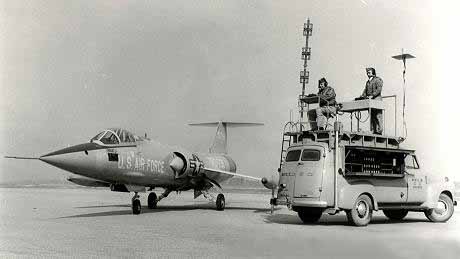
QF-104A control vehicle at Eglin AFB, Florida 1961 |
||
| copyright: IFS Zipper magazines | ||
| compiled by: Hubert Peitzmeier | ||
| updated: November 22, 2025 | ||
Any contribution or proven correction is highly welcome, please contact
the webmaster 
| ||
 |
||